

Showing posts with label Potential Themes. Show all posts
Showing posts with label Potential Themes. Show all posts
Wednesday, 19 October 2011

Friday, 2 September 2011
The Tides and the Moon
The tides on the Earth are mostly generated by the gradient in intensity of the Moon's gravitational pull from one side of the Earth to the other, the tidal forces. This forms two tidal bulges on the Earth, which are most clearly seen in elevated sea level as ocean tides. Since the Earth spins about 27 times faster than the Moon moves around it, the bulges are dragged along with the Earth's surface faster than the Moon moves, rotating around the Earth once a day as it spins on its axis. The ocean tides are magnified by other effects: frictional coupling of water to Earth's rotation through the ocean floors, the inertia of water's movement, ocean basins that get shallower near land, and oscillations between different ocean basins. The gravitational attraction of the Sun on the Earth's oceans is almost half that of the Moon, and their gravitational interplay is responsible for spring and neap tides.
Over one lunar month more than half of the Moon's surface can be seen from the surface of the Earth.
The libration of the Moon over a single lunar month.
Gravitational coupling between the Moon and the bulge nearest the Moon acts as a torque on the Earth's rotation, draining angular momentum and rotational kinetic energy from the Earth's spin. In turn, angular momentum is added to the Moon's orbit, accelerating it, which lifts the Moon into a higher orbit with a longer period. As a result, the distance between the Earth and Moon is increasing, and the Earth's spin slowing down. Measurements from lunar ranging experiments with laser reflectors left during the Apollo missions have found that the Moon's distance to the Earth increases by 38 mm per year (though this is only 0.10 ppb/year of the radius of the Moon's orbit). Atomic clocks also show that the Earth's day lengthens by about 15 microseconds every year, slowly increasing the rate at which UTC is adjusted by leap seconds. Left to run its course, this tidal drag would continue until the spin of the Earth and the orbital period of the Moon matched. However, the Sun will become a red giant long before that, engulfing the Earth.
The lunar surface also experiences tides of amplitude ~10 cm over 27 days, with two components: a fixed one due to the Earth, as they are in synchronous rotation, and a varying component from the Sun. The Earth-induced component arises from libration, a result of the Moon's orbital eccentricity; if the Moon's orbit were perfectly circular, there would only be solar tides. Libration also changes the angle from which the Moon is seen, allowing about 59% of its surface to be seen from the Earth (but only half at any instant). The cumulative effects of stress built up by these tidal forces produces moonquakes. Moonquakes are much less common and weaker than earthquakes, although they can last for up to an hour – a significantly longer time than terrestrial earthquakes – because of the absence of water to damp out the seismic vibrations. The existence of moonquakes was an unexpected discovery from seismometers placed on the Moon by Apollo astronauts from 1969 through 1972.


Poseidon (Greek: Ποσειδῶν) was the god of the sea, and, as "Earth-Shaker," of earthquakes in Greek mythology. The name of the sea-god Nethuns in Etruscan was adopted in Latin for Neptune in Roman mythology: both were sea gods analogous to Poseidon. Linear B tablets show that Poseidon was venerated at Pylos and Thebes in pre-Olympian Bronze Age Greece, but he was integrated into the Olympian gods as the brother of Zeus and Hades. Poseidon has many children. There is a Homeric hymn to Poseidon, who was the protector of many Hellenic cities, although he lost the contest for Athens to Athena.
[http://en.wikipedia.org/wiki/Neptune_%28mythology%29]


Neptune (Latin: Neptūnus) was the god of water and the sea in Roman mythology and religion. He is analogous with, but not identical to, the Greek god Poseidon. In the Greek-influenced tradition, Neptune was the brother of Jupiter and Pluto, each of them presiding over one of the three realms of the universe, Heaven, Earth and the Netherworld. Depictions of Neptune in Roman mosaics, especially those of North Africa, are influenced by Hellenistic conventions.
Unlike the Greek Oceanus, titan of the world-ocean, Neptune was associated as well with fresh water. Georges Dumézil suggested that for Latins, who were not a seafaring people, the primary identification of Neptune was with freshwater springs. Like Poseidon, Neptune was worshipped by the Romans also as a god of horses, under the name Neptunus Equester, a patron of horse-racing.
[http://en.wikipedia.org/wiki/Poseidon]
Thursday, 1 September 2011
Mandala


Maṇḍala (मण्डल) is a Sanskrit word that means "circle". In the Hindu and Buddhist religious traditions their sacred art often takes a mandala form. The basic form of most Hindu and Buddhist mandalas is a square with four gates containing a circle with a center point. Each gate is in the shape of a T.
These mandalas, concentric diagrams, have spiritual and ritual significance in both Buddhism and Hinduism. The term is of Hindu origin and appears in the Rig Veda as the name of the sections of the work, but is also used in other Indian religions, particularly Buddhism. In the Tibetan branch of Vajrayana Buddhism, mandalas have been developed into sandpainting. They are also a key part of anuttarayoga tantra meditation practices.
In various spiritual traditions, mandalas may be employed for focusing attention of aspirants and adepts, as a spiritual teaching tool, for establishing a sacred space, and as an aid to meditation and trance induction. According to the psychologist David Fontana, its symbolic nature can help one "to access progressively deeper levels of the unconscious, ultimately assisting the meditator to experience a mystical sense of oneness with the ultimate unity from which the cosmos in all its manifold forms arises." The psychoanalyst Carl Jung saw the mandala as "a representation of the unconscious self,"[citation needed] and believed his paintings of mandalas enabled him to identify emotional disorders and work towards wholeness in personality.
In common use, mandala has become a generic term for any plan, chart or geometric pattern that represents the cosmos metaphysically or symbolically, a microcosm of the Universe from the human perspective.
[http://en.wikipedia.org/wiki/Mandala]
Wednesday, 31 August 2011
The Metatron’s Cube


The Metatron’s Cube is a two-dimensional geometric figure created from 13 equal circles with lines from the center of each circle extending out to the centers of the other 12 circles. Six circles are placed in a hexagonal pattern around a central circle, with six more extending out along the same radial lines.
Metatron’s Cube shares 2-D resonance with the Flower of Life. It is a Sacred Geometry figure. Its name makes reference to Metatron, though historical reference, other than the name itself, is elusive.
The pattern delineated by many of the lines can be created by orthographic projections of the first three Platonic solids. Specifically, the line pattern includes projections of a double tetrahedron (aka stellated octahedron), a cube within a cube (aka a tesseract), and an octahedron. Although the image below shows the dodecahedron and the icosahedron fitting to the pattern of Metatron’s Cube, the vertices of those shapes do not coincide with the centers of the 13 circles.
Monday, 29 August 2011
CEV

Closed-eye hallucinations and closed-eye visualizations (CEV) are a distinct class of hallucination. These types of hallucinations generally only occur when one's eyes are closed or when one is in a darkened room. They are a form of phosphene.
Certain users report closed-eye hallucinations under the influence of psychedelics. These are reportedly of a different nature than the "open-eye" hallucinations of the same compounds.
Levels of CEV perception
There are five known levels of CEV perception which can be achieved either through chemical stimuli or through meditative relaxation techniques.
[edit] Level 1: Visual noise
CEV noise simulation
The most basic form of CEV perception that can be immediately experienced in normal waking consciousness involves a seemingly random noise of pointillistic light/dark regions with no apparent shape or order.
This can be seen when the eyes are closed and looking at the back of the eyelids. In a bright room, a dark red can be seen, owing to a small amount of light penetrating the eyelids and taking on the color of the blood within them. In a dark room, blackness can be seen or the object can be more colourful. But in either case it is not a flat unchanging redness/blackness. Instead, if actively observed for a few minutes, one becomes aware of an apparent disorganized motion, a random field of lightness/darkness that overlays the redness/blackness of your closed eyelids.
For a person who tries to actively observe this closed-eye perception on a regular basis, there comes a point where if they look at a flat-shaded object with their eyes wide open, and try to actively look for this visual noise, they will become aware of it and see the random pointillistic disorganized motion as if it were a translucent overlay on top of what is actually being seen by their open eyes.
When seen overlaid onto the physical world, this CEV noise does not obscure physical vision at all, and in fact is hard to notice if the visual field is highly patterned, complex, or in motion. When active observation is stopped, it is not obvious or noticeable, and seemingly disappears from normal physical perception. Individuals suffering from visual snow see similar noise but experience difficulty blocking it from conscious perception.
The noise probably originates from thermal noise exciting the photoreceptor cells in the retina[citation needed]
[edit] Level 2: Light/dark flashes
Some mental control can be exerted over these closed-eye visualizations, but it usually requires a bit of relaxation and concentration to achieve. When properly relaxed it is possible to cause regions of intense black, bright white or even colors such as yellow, green, or pink to appear in the noise. These regions can span the entire visual field, but seem to be fleeting in nature.[1]
[edit] Level 3: Patterns, motion, and color
CEV pattern simulation, note that this can be quite different from real life experience
This level is relatively easily accessible to people who use LSD, and appears to be what most people refer to as colourful visuals. However, it is also accessible to people involved in deep concentration for long periods of time. When lying down at night and closing the eyes, right before sleep the complex motion of these patterns can become directly visible without any great effort thanks to hypnagogic hallucination. The patterns themselves might resemble fractals.
[edit] Level 4: Objects and things
This is a fairly deep state. At this level, thoughts visually manifest as objects or environments. When this level is reached, the CEV noise seems to calm down and fade away, leaving behind an intense flat ordered blackness. The visual field becomes a sort of active space. A side component of this is the ability to feel motion when the eyes are closed.[citation needed]
Opening the eyes returns one to the normal physical world, but still with the CEV object field overlaid onto it and present. In this state it is possible to see things that appear to be physical objects in the open-eye physical world, but that aren't really there.
“ If we remember that the essential difference between what we call the real world and the world of imagination and hallucination, is not the elements of which we build them up but the sequence in which these elements appear... then it follows that the sequences directed from without represent a limitation of the otherwise unlimited combinations of the selective forms released at random from within ”
—- Jurij Moskvitin, Essay on the origin of thought.
[edit] Level 5: Overriding physical perception
This is the point where it appears to the outside world that a person is either unconscious or insane. The internal CEV perceptions and think-it/feel-it perceptions become stronger than physical perceptions, and completely override and replace open-eye physical perceptions. This can be a potentially dangerous state if a person is still mobile while in a different imagined world, but by this time most people are motionless and not likely to do something hazardous to themselves or others. This is the point where most hallucinogenic references say it is a good idea to have a "sitter" present to watch over the person using the chemicals, and keep them from accidentally harming themselves or others while deep into their own world.[citation needed]
What is not a CEV
Image burn-in (afterimage)
Image burn-in occurs when very bright objects lie in one's field of vision, and should not be confused with closed-eye hallucinations. Visual burn-in from bright lights is visible for a few minutes after closing the eyes, or by blinking repeatedly, but the burn-in effect slowly fades away as the retina recovers, whereas the waking-consciousness CEV noise will not disappear if observed continuously over a period of time.
Corneal liquid
CEV does not involve the liquid and air bubbles on the surface of the cornea, which can also be seen by extremely nearsighted people when looking at bright point-light sources with glasses/contacts removed. Half-closing and reopening the eyelids creates a very definite wiper-ridge in the corneal liquid that is readily visible. Fully closing and reopening the eyelids also stirs up the corneal liquid which settles down after a brief moment. The motion of waking-consciousness CEV noise is not so directly and physically controllable and repeatable. This is not necessarily only associated with extreme nearsightedness.
Blue-sky sprites
CEV does not seem to be related to the "sprites" (blue field entoptic phenomenon) that can be seen as dots darting around when staring up into a bright blue sky on a sunny day (not looking at the sun). These dots superimposed over a flat blue background are white blood cells moving through the blood vessels of the retina. The motion of waking-consciousness CEV noise is uniformly random compared to the waking-consciousness blue-sky sprite motion.
Physical retinal stimulation
CEV is unrelated to the visual noise seen when the retina is physically stimulated. The retina can be made to produce light patterns of visual noise simply by one rubbing their eyes somewhat forcefully in a manner that increases intraocular pressure. Additionally retinal noise can be produced by touching near the rear of the eyeball (for example, if one closes their eyes, looks all the way left, and lightly touches the rightmost part of the eye socket, this produces visual noise in the shape of a circle that appears at the left side of the visual field - a practice that is neither painful nor dangerous). None of these are closed-eye hallucinations.
Floaters
Floaters are faint objects that may be noticed in front of light areas, such as a blue sky. They often appear like cells floating across the eye. Many believe they are illusions but are real objects inside the eye and are the remains of cells.
[http://en.wikipedia.org/wiki/Closed-eye_hallucination]
Wednesday, 10 August 2011


Deoxyribonucleic acid (/diˌɒksiˌraɪbɵ.njuːˌkleɪ.ɨk ˈæsɪd/ ( listen)) — DNA — is a nucleic acid that contains the genetic instructions used in the development and functioning of all known living organisms (with the exception of RNA viruses). The main role of DNA molecules is the long-term storage of information. DNA is often compared to a set of blueprints, like a recipe or a code, since it contains the instructions needed to construct other components of cells, such as proteins and RNA molecules. The DNA segments that carry this genetic information are called genes, but other DNA sequences have structural purposes, or are involved in regulating the use of this genetic information. Along with RNA and proteins, DNA is one of the three major macromolecules that are essential for all known forms of life.
DNA consists of two long polymers of simple units called nucleotides, with backbones made of sugars and phosphate groups joined by ester bonds. These two strands run in opposite directions to each other and are therefore anti-parallel. Attached to each sugar is one of four types of molecules called nucleobases (informally, bases). It is the sequence of these four nucleobases along the backbone that encodes information. This information is read using the genetic code, which specifies the sequence of the amino acids within proteins. The code is read by copying stretches of DNA into the related nucleic acid RNA in a process called transcription.
Within cells DNA is organized into long structures called chromosomes. During cell division these chromosomes are duplicated in the process of DNA replication, providing each cell its own complete set of chromosomes. Eukaryotic organisms (animals, plants, fungi, and protists) store most of their DNA inside the cell nucleus and some of their DNA in organelles, such as mitochondria or chloroplasts. In contrast, prokaryotes (bacteria and archaea) store their DNA only in the cytoplasm. Within the chromosomes, chromatin proteins such as histones compact and organize DNA. These compact structures guide the interactions between DNA and other proteins, helping control which parts of the DNA are transcribed.
[http://en.wikipedia.org/wiki/DNA]
Monday, 8 August 2011


Flower Of Life


The Flower of Life is the modern name given to a geometrical figure composed of multiple evenly-spaced, overlapping circles. They are arranged to form a flower-like pattern with a sixfold symmetry, similar to a hexagon. The center of each circle is on the circumference of six surrounding circles of the same diameter.
It is considered by some to be a symbol of sacred geometry, said to contain ancient, religious value depicting the fundamental forms of space and time.In this sense, it is a visual expression of the connections life weaves through all sentient beings, and it is believed to contain a type of Akashic Record of basic information of all living things.
There are many spiritual beliefs associated with the Flower of Life; for example, depictions of the five Platonic Solids are found within the symbol of Metatron's Cube,[citation needed] which may be derived from the Flower of Life pattern. These platonic solids are geometrical forms which are said to act as a template from which all life springs.
According to Drunvalo Melchizedek, in the Judeo-Christian tradition, the stages which construct the Seed of Life are said to represent the six days of Creation, in which Elohim created life; Genesis 2:2-3, Exodus 23:12, 31:16-17, Isaiah 56:6-8. Within these stages, among other things, are the symbols of the Vesica Piscis, an ancient religious symbol, and Borromean rings, which represents the Holy Trinity.


Sunday, 7 August 2011
The Lovers

Love is an emotion of strong affection and personal attachment. In philosophical context, love is a virtue representing all of human kindness, compassion, and affection. Love is central to many religions, as in the Christian phrase, "God is love" or Agape in the Canonical gospels. Love may also be described as actions towards others (or oneself) based on compassion, or as actions towards others based on affection.
In English, the word love can refer to a variety of different feelings, states, and attitudes, ranging from generic pleasure ("I loved that meal") to intense interpersonal attraction ("I love my partner"). "Love" can also refer specifically to the passionate desire and intimacy of romantic love, to the sexual love of eros (cf. Greek words for love), to the emotional closeness of familial love, or to the platonic love that defines friendship, to the profound oneness or devotion of religious love. This diversity of uses and meanings, combined with the complexity of the feelings involved, makes love unusually difficult to consistently define, even compared to other emotional states.
Love in its various forms acts as a major facilitator of interpersonal relationships and, owing to its central psychological importance, is one of the most common themes in the creative arts.


Saturday, 6 August 2011
Serpent


Serpent is a word of Latin origin (from serpens, serpentis "something that creeps, snake") that is commonly used in a specifically mythic or religious context, signifying a snake that is to be regarded not as a mundane natural phenomenon nor as an object of scientific zoology, but as the bearer of some potent symbolic value. Snakes have been associated with some of the oldest rituals known to humankind.
[http://en.wikipedia.org/wiki/Serpent_%28symbolism%29]
The caduceus (play /kəˈdjuːsiːəs/ or /kəˈdjuːʃəs/; from Greek κηρύκειον kērukeion "herald's staff" ) is the staff carried by Hermes in Greek mythology. The same staff was also borne by heralds in general, for example by Iris, the messenger of Hera. It is a short staff entwined by two serpents, sometimes surmounted by wings. In Roman iconography it was often depicted being carried in the left hand of Mercury, the messenger of the gods, guide of the dead and protector of merchants, shepherds, gamblers, liars and thieves.


Like Crystal


A crystal or crystalline solid is a solid material whose constituent atoms, molecules, or ions are arranged in an orderly repeating pattern extending in all three spatial dimensions. The scientific study of crystals and crystal formation is known as crystallography. The process of crystal formation via mechanisms of crystal growth is called crystallization or solidification. The word crystal is derived from the Ancient Greek word κρύσταλλος (krustallos), meaning both “ice” and “rock crystal”, from κρύος (kruos), “icy cold, frost”.
[http://en.wikipedia.org/wiki/Crystal]
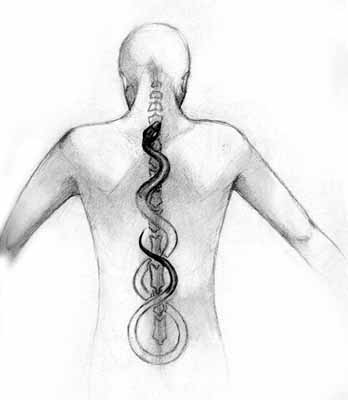
kundalini


Kundalini (kuṇḍalinī, Sanskrit: कुण्डलिनी, Thai: กุณฺฑลินี) literally means coiled. In yoga, a "corporeal energy" - an unconscious, instinctive or libidinal force or Shakti, lies coiled at the base of the spine. It is envisioned either as a goddess or else as a sleeping serpent, hence a number of English renderings of the term such as 'serpent power'. The kundalini resides in the sacrum bone in three and a half coils and has been described as a residual power of pure desire.
Kundalini is described as a sleeping, dormant potential force in the human organism.[6] It is one of the components of an esoteric description of man's 'subtle body', which consists of nadis (energy channels), chakras (psychic centres), prana (subtle energy), and bindu (drops of essence).
Kundalini is described[who?] as being coiled up at the base of the spine, usually within muladhara chakra. The image given[who?] is that of a serpent coiled three and a half times around a smokey grey lingam. Each coil is said[who?] to represent one of the three gunas, with the half coil signifying transcendence.
Through meditation, and various esoteric practices, such as kundalini yoga, laya-yoga, and kriya yoga, the kundalini is awakened, and can rise up through the central nadi, called sushumna, that rises up inside or alongside the spine. The progress of kundalini through the different chakras leads to different levels of awakening and mystical experience, until the kundalini finally reaches the top of the head, Sahasrara chakra, producing an extremely profound mystical experience.
[http://en.wikipedia.org/wiki/Kundalini]

Thursday, 4 August 2011
9

another representation of higher conciousness symbolised as the water drop.
The nine consciousnesses can be thought of as different layers of consciousness which are constantly operating together to create our lives. The Sanskrit word vijnāna, which is translated as consciousness, includes a wide range of activities, including sensation, cognition and conscious thought. The first five of these consciousnesses are the familiar senses of sight, hearing, smell, taste and touch. The sixth consciousness is the function that integrates and processes the various sensory data to form an overall picture or thought, identifying what it is that our five senses are communicating to us. It is primarily with these six functions of life that we perform our daily activities.
Buddhism posits that our thoughts, words and deeds invariably create an imprint in the deep layers of the eighth consciousness. This is what Buddhists refer to as karma. The eighth consciousness is therefore sometimes referred to as the karmic storehouse--the place where these karmic "seeds" are "stored." These seeds or latent energy can be either positive or negative; the eighth consciousness remains neutral and equally receptive to either type of karmic imprinting. The energy becomes manifest when conditions are ripe. Positive latent causes can become manifest as both positive effects in one's life and as positive psychological functions such as trust, nonviolence, self-control, compassion and wisdom. Negative latent causes can manifest as various forms of delusion and destructive behavior and give rise to suffering for ourselves and others.
While the image of a storehouse is helpful, a truer image may be that of a raging torrent of karmic energy. This energy is constantly moving through and shaping our lives and experience. Our resultant thoughts and actions are then fed back into this karmic flow. The quality of the karmic flow is what makes each of us distinct beings--our unique selves. The flow of energy is constantly changing, but, like a river, it maintains an identity and consistency even through successive cycles of life and death. It is this aspect of fluidity, this lack of fixity, that opens the possibility to transforming the content of the eighth consciousness. This is why karma, properly understood, is different from an unchanging or unavoidable destiny.
The question, therefore, is how we increase the balance of positive karma. This is the basis for various forms of Buddhist practice that seek to imprint positive causes in our lives. When caught up in a cycle of negative cause and effect, however, it is difficult to avoid making further negative causes, and it is here that we turn to the most fundamental layer of consciousness, the ninth or amala consciousness.
This can be thought of as the life of the cosmos itself; it is also referred to as the fundamentally pure consciousness. Unstained by the workings of karma, this consciousness represents our true, eternal self. The revolutionary aspect of Nichiren Buddhism is that it seeks to directly bring forth the energy of this consciousness--the enlightened nature of the Buddha--thus purifying the other, more superficial layers of consciousness. The great power of the ninth consciousness welling forth changes even entrenched patterns of negative karma in the eighth consciousness. Because the eighth consciousness transcends the boundaries of the individual, merging with the latent energy of one's family, one's ethnic group, and also with that of animals and plants, a positive change in this karmic energy becomes a "cogwheel" for change in the lives of others. As SGI President Ikeda writes, "When we activate this fundamentally pure consciousness, the energy of all life's good and evil karma is directed toward value creation; and the mind or consciousness . . . of humankind is infused with the life current of compassion and wisdom." Nichiren identified the practice of chanting the phrase Nam-myoho-renge-kyo as the basic means for activating the ninth consciousness in our lives.
As the layers of consciousness are transformed, they each give rise to unique forms of wisdom. The wisdom inherent in the eighth consciousness allows us to perceive ourselves, our experience and other phenomena with perfect clarity and to profoundly appreciate the interconnectedness and interdependence of all things. As the deep-rooted delusions of the seventh consciousness are transformed, an individual is enabled to overcome the fear of death, as well as the aggression and violence that spring from this fear. A wisdom arises which enables us to perceive the fundamental equality of all living beings and to deal with them on an unchanging basis of respect. It is this type of transformation and wisdom that is sorely required in our world today.
[http://www.sgiquarterly.org/buddhism2004Apr-1.html]
Subscribe to:
Posts (Atom)