Showing posts with label Chakra. Show all posts

Wednesday, 10 August 2011


Monday, 8 August 2011


Sunday, 7 August 2011


Saturday, 6 August 2011

Serpent


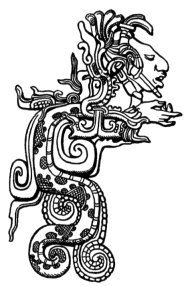
Serpent is a word of Latin origin (from serpens, serpentis "something that creeps, snake") that is commonly used in a specifically mythic or religious context, signifying a snake that is to be regarded not as a mundane natural phenomenon nor as an object of scientific zoology, but as the bearer of some potent symbolic value. Snakes have been associated with some of the oldest rituals known to humankind.

[http://en.wikipedia.org/wiki/Serpent_%28symbolism%29]


The caduceus (play /kəˈdjuːsiːəs/ or /kəˈdjuːʃəs/; from Greek κηρύκειον kērukeion "herald's staff" ) is the staff carried by Hermes in Greek mythology. The same staff was also borne by heralds in general, for example by Iris, the messenger of Hera. It is a short staff entwined by two serpents, sometimes surmounted by wings. In Roman iconography it was often depicted being carried in the left hand of Mercury, the messenger of the gods, guide of the dead and protector of merchants, shepherds, gamblers, liars and thieves.


kundalini


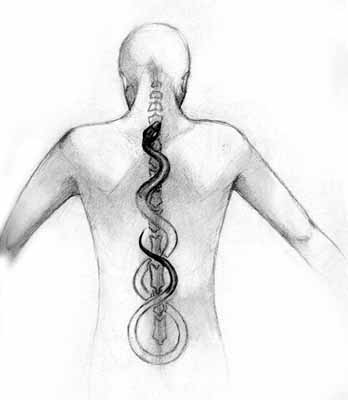
Kundalini (kuṇḍalinī, Sanskrit: कुण्डलिनी, Thai: กุณฺฑลินี) literally means coiled. In yoga, a "corporeal energy" - an unconscious, instinctive or libidinal force or Shakti, lies coiled at the base of the spine. It is envisioned either as a goddess or else as a sleeping serpent, hence a number of English renderings of the term such as 'serpent power'. The kundalini resides in the sacrum bone in three and a half coils and has been described as a residual power of pure desire.

Kundalini is described as a sleeping, dormant potential force in the human organism.[6] It is one of the components of an esoteric description of man's 'subtle body', which consists of nadis (energy channels), chakras (psychic centres), prana (subtle energy), and bindu (drops of essence).

Kundalini is described[who?] as being coiled up at the base of the spine, usually within muladhara chakra. The image given[who?] is that of a serpent coiled three and a half times around a smokey grey lingam. Each coil is said[who?] to represent one of the three gunas, with the half coil signifying transcendence.

Through meditation, and various esoteric practices, such as kundalini yoga, laya-yoga, and kriya yoga, the kundalini is awakened, and can rise up through the central nadi, called sushumna, that rises up inside or alongside the spine. The progress of kundalini through the different chakras leads to different levels of awakening and mystical experience, until the kundalini finally reaches the top of the head, Sahasrara chakra, producing an extremely profound mystical experience.

[http://en.wikipedia.org/wiki/Kundalini]

Tuesday, 2 August 2011

Meditation


Meditation refers to any of a family of practices in which the practitioner trains his or her mind or self-induces a mode of consciousness in order to realize some benefit.
Meditation is generally an internally-invoked, personal practice, which an individual can do by themselves. Prayer beads or other ritual objects may be used during meditation. Meditation may involve invoking or cultivating a feeling or internal state, such as compassion, or attending to a specific focal point. The term can refer to the state itself, as well as to practices or techniques employed to cultivate the state.
There are dozens or more specific styles of meditation practice; the word meditation may carry different meanings in different contexts. Meditation has been practiced since antiquity as a component of numerous religious traditions.


Since the 1960s, meditation has been the focus of increasing scientific research of uneven rigor and quality. In over 1,000 published research studies, various methods of meditation have been linked to changes in metabolism, blood pressure, brain activation, and other bodily processes. Meditation has been used in clinical settings as a method of stress and pain reduction.

Monday, 1 August 2011

7

Seated


Chakra

Chakra is a concept originating in Hindu texts, featured in tantric and yogic traditions of Hinduism and Buddhism. Its name derives from the Sanskrit word for "wheel" or "turning" (cakraṃ चक्रं [ˈtʃəkrə̃], pronounced [ˈtʃəkrə] in Hindi; Pali: cakka चक्क, Thai: จักระ, Tamil: சக்கரம், Kannada : ಚಕ್ರ, Chinese: , Tibetan: འཁོར་ལོ་; khorlo)
Chakra is a concept referring to wheel-like vortices which, according to traditional Indian medicine, are believed to exist in the surface of the etheric double of man. The Chakras are said to be "force centres" or whorls of energy permeating, from a point on the physical body, the layers of the subtle bodies in an ever-increasing fan-shaped formation. Rotating vortices of subtle matter, they are considered the focal points for the reception and transmission of energies.Different systems posit a varying number of chakras; the most well known system in the West is that of seven chakras.

It is typical for chakras to be depicted as either flower-like or wheel-like. In the former, "petals" are shown around the perimeter of a circle. In the latter, spokes divide the circle into segments that make the chakra resemble a wheel (or "chakra"). Each chakra possesses a specific number of segments or petals.


[http://en.wikipedia.org/wiki/Chakra]